Stock Abbreviation : Topsec      Stock Code : 002212
7*24 hour service: 400-777-0777

Cloud Security

Security Coexists with the Cloud, Empowering a Digital Future

Background

With the deepening of digital transformation, cloud computing has become a critical foundation for enterprise innovation and development. While migrating services to the cloud brings advantages such as elasticity, agility, cost efficiency, and operational optimization, it also introduces new security challenges: increasingly stringent compliance requirements, continuously evolving attack techniques, dynamically shifting threat landscapes, and heightened security management complexity under the shared responsibility model. In the face of cloud-native, hybrid multi-cloud environments, traditional security perimeters are gradually losing effectiveness, making the construction of an active defense system deeply integrated with cloud architectures indispensable. Through systematic cloud security capabilities and continuous risk management, TalentSec is committed to helping customers fully harness the power of the cloud while building reliable security defenses, ensuring stable, trusted, and sustainable innovation and growth for their cloud-based businesses.

Relevant Policies
2025
In 2025, the group standard *"Information Security Technology — Guidance for Classified Protection Cybersecurity Assessment in Cloud Computing" (GA/T 2347-2025)* was issued. It provides assessment guidance for cybersecurity classified protection specifically for cloud computing scenarios. It addresses the applicability issues of traditional assessment methods in environments featuring elastic and shared cloud computing resources.
2024
In 2024, the national standard "Information Technology—Cloud Computing Reference Architecture" (GB/T 32399-2024) clarified the security responsibilities and relationships among participating roles such as cloud service customers, cloud service providers, cloud brokers, cloud auditors, and cloud infrastructure network operators.
2024
In 2024, the Cloud Security Alliance (CSA) released the "Security Guidance for Critical Areas of Focus in Cloud Computing" Version 5 (v5), which covers 12 key domains (including data security, identity and access management, compliance, etc.) and serves as a comprehensive best practices framework for cloud security.
2019
In 2019, the national standard "Information Security Technology—Baseline for Classified Protection of Cybersecurity" (GB/T 22239-2019) introduced extended requirements for the cloud computing security section.
2019
In 2019, the national standard "Information Security Technology—Evaluation Requirements for Classified Protection of Cybersecurity" (GB/T 22239-2019) stipulated requirements for the evaluation of the cloud computing security section.
2017
In 2017, the national standard "Security Specifications for Cloud Computing-Based E-Government Public Platform – Part 1: General Requirements" (GB/T 34080.1-2017) defined the security architecture framework for cloud computing-based e-government public platforms, covering resource, service, operation and maintenance, and management security.
2025
In 2025, the group standard *"Information Security Technology — Guidance for Classified Protection Cybersecurity Assessment in Cloud Computing" (GA/T 2347-2025)* was issued. It provides assessment guidance for cybersecurity classified protection specifically for cloud computing scenarios. It addresses the applicability issues of traditional assessment methods in environments featuring elastic and shared cloud computing resources.
Development Trend
Artificial Intelligence is Reshaping the Paradigm of Cloud Security Operations

Artificial Intelligence and Machine Learning are evolving from technological tools into the core driving engines of cloud security. The massive data, elastic computing power, and automated architecture inherent to cloud environments provide a natural foundation for the deep application of AI technologies. This enables security capabilities to shift comprehensively from rule-based passive responses to behavior-based proactive sensing and prediction. Through AI-driven threat hunting, anomalous behavior analysis, automated attack chain investigation, and intelligent response handling, cloud security operations are undergoing a paradigm upgrade from "labor-intensive" to "intelligent and efficient," establishing a continuously adaptive, dynamically evolving active defense system.

Cloud-Native Security Reshapes the Protection Framework

The widespread adoption of containers, microservices, and serverless architectures is driving a profound transformation in security paradigms. The focus of protection is shifting from network perimeters to the applications themselves, pushing security capabilities leftward into the development process and enabling automated security through DevSecOps. Security measures for container images, inter-service communication, APIs, and software supply chains have become critical to building inherent security.

Multi-Cloud and Hybrid Cloud Management

With the widespread adoption of multi-cloud and hybrid cloud architectures, ensuring security isolation and coordinated protection across different cloud platforms has become a critical challenge. Looking ahead, the standardization of multi-cloud and hybrid cloud security management will emerge as a significant trend, aimed at reducing the complexity of cross-cloud security administration and enhancing overall security posture.

Users' Pain Points
The Challenge of Blurred Cloud Environment Boundaries and Proliferation of East-West Attacks
In cloud computing architectures, traditional physical network boundaries have dissolved, making communication between virtual machines and containers (east-west traffic) the predominant data flow. Once an attack breaches the external perimeter, it can easily spread laterally within the cloud, leading to large-scale impact. Traditional firewalls based on physical locations are unable to effectively isolate and control the dynamic, logical communications within the cloud. This results in "invisible internal risks" and a lack of effective control measures.
Meeting the Demands for Dynamic Elasticity of Cloud Resources and Agile, On-Demand Security Policies
The nature of cloud environments is on-demand usage and elastic scaling, where business virtual machines or container instances may be frequently created, migrated, or terminated. Traditional static, manually configured security policies cannot keep pace with such rapid changes, leading to security coverage gaps or policy lag. This creates a security risk characterized by "non-fixed boundaries."
Protecting Cloud-Native Applications and Data Against Emerging Security Risks
As enterprises adopt cloud-native technologies such as containers, microservices, and APIs, the attack surface expands from the infrastructure layer to the application and data layers. Container image vulnerabilities, insecure API interfaces, and similar issues have become new threat vectors. Simultaneously, the multi-tenant, shared environment of the cloud amplifies the risks of data leakage and misuse.
Technical System
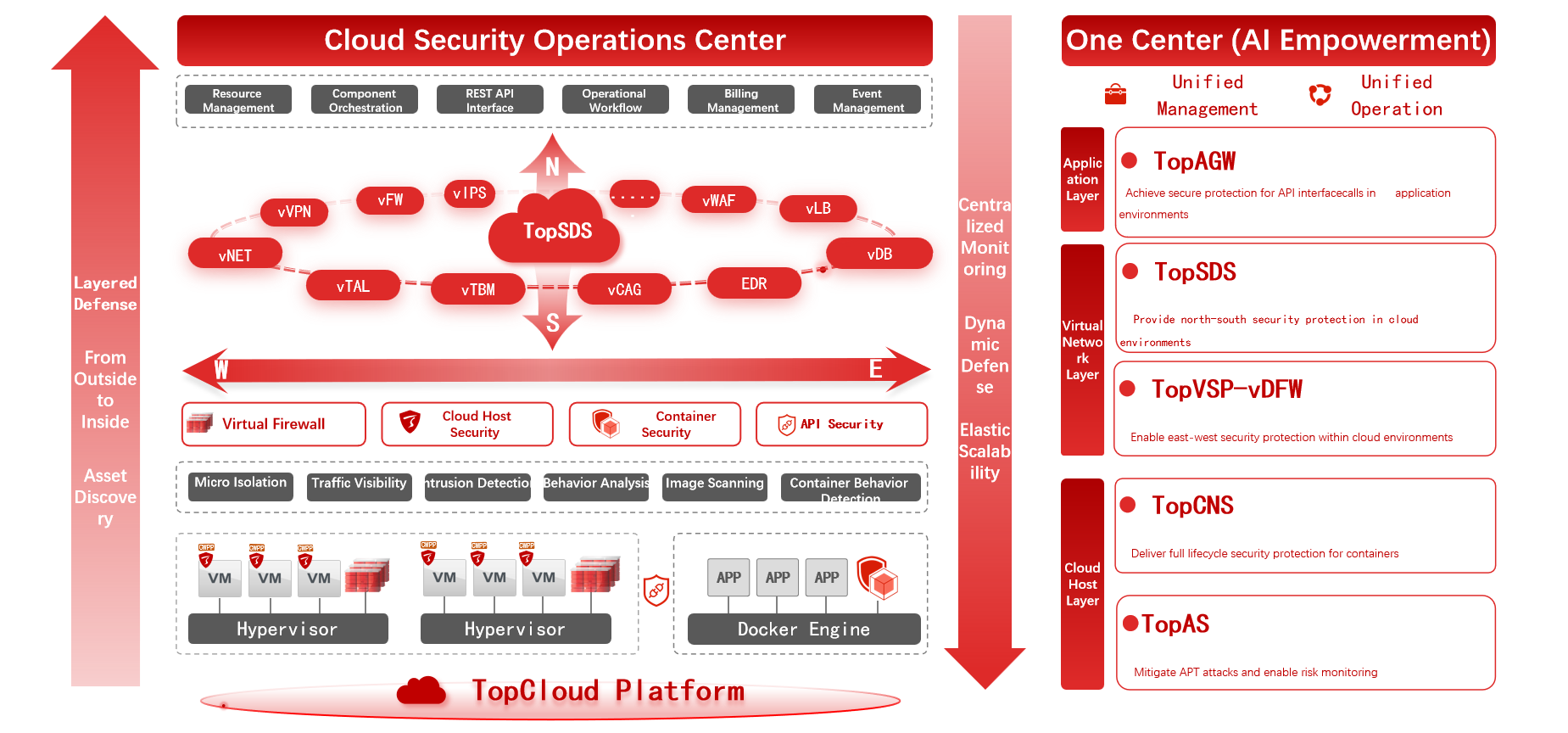
Topsec Cloud Security Technology Architecture employs a Cloud Security Operations Center (CSOC) as its intelligent core, achieving unified management of security resources, automated policy orchestration, and a closed-loop operational workflow. At the protection level, the system consolidates virtualized security capabilities through a Cloud Security Resource Pool to fortify north-south traffic protection at the cloud boundary. Leveraging virtualized distributed firewalls and cloud workload/container security products, it enables fine-grained isolation and advanced threat defense for east-west traffic within the cloud, effectively containing lateral movement risks. Furthermore, by integrating cloud-native security capabilities such as micro-segmentation and API security gateways, the architecture provides full-lifecycle protection for cloud-native applications like containers and microservices. This architecture has been successfully deployed across numerous sectors including government, healthcare, and energy. It assists customers in building a multi-layered, proactive "Cloud+Network+Endpoint" defense-in-depth system that meets compliance requirements such as China's Multi-Level Protection Scheme (MLPS), while also enhancing security operational efficiency and reducing costs.
Comprehensive Strength
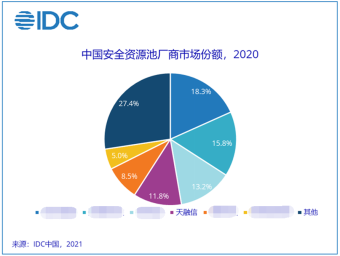
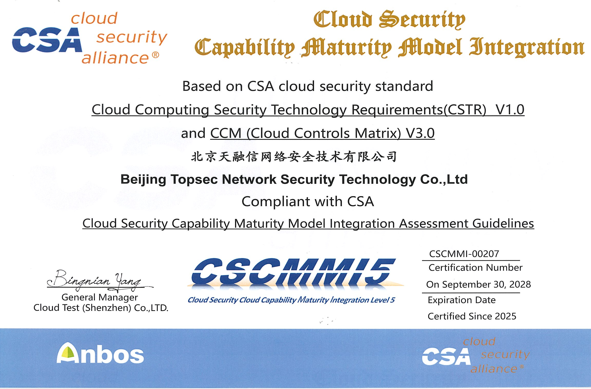
Topsec, drawing on over two decades of deep cybersecurity practice, consistently upholds the philosophy of "empowering security with the cloud, aiding the cloud with security, and achieving the integrated symbiosis of cloud and security." The company has established a comprehensive portfolio of products and solutions covering domains such as cloud firewalls, cloud security resource pools, and Cloud Workload Protection Platforms (CWPP). Among these, the Topsec Defense-in-Depth Security Framework has been deployed across more than 30 business scenarios, including government cloud and healthcare cloud, and has received authoritative recognition such as being named among the "2024 Top Ten Outstanding Cybersecurity Innovations." Several core products and solutions have been featured in reports by leading authorities like IDC and the China Academy of Information and Communications Technology (CAICT). To date, Topsec's cloud security capabilities comprehensively serve numerous industries, including government, telecommunications, energy, finance, and education, securing the cloud infrastructure for over 1,500 government and enterprise clients. In the realm of standards leadership and technological innovation, TalentSec has led or participated in the formulation of more than 20 cloud security standards and has undertaken multiple national-level research projects commissioned by state ministries. Based on extensive industry practice, Topsec actively advocates for and implements the systematic concept of "synchronizing security planning with cloud construction," continuously building a trustworthy and reliable cloud security foundation for enterprises across all sectors.