Stock Abbreviation : Topsec      Stock Code : 002212
7*24 hour service: 400-777-0777

Data Security

To ensure security and controllability throughout the data lifecycle

Background

With information technology becoming increasingly intertwined with human production and daily life, the digital transformation process continues to advance, leading to an explosive growth and massive aggregation of global data. Data security is not only crucial for economic development, social stability, and public well-being but also holds profound strategic significance for national security. Since 2021, fundamental laws such as the Cybersecurity Law of the People's Republic of China, the Data Security Law of the People's Republic of China, and the Personal Information Protection Law of the People's Republic of China have come into effect. Together, they form the legal cornerstone for data security in China, marking the comprehensive entry of data security governance into a "new era of compliance," characterized by systematic, standardized, and legalized frameworks.

Against this backdrop, balancing data security with development and utilization has become a core issue in promoting the high-quality growth of the digital economy. Currently, China is accelerating the construction of a data governance system that emphasizes both security and development, as well as the protection and utilization of data resources. Efforts are being made to facilitate the compliant, orderly flow, and efficient use of data resources within a secure and controllable framework. This provides solid institutional guarantees and innovative momentum for the development of a Digital China.

Relevant Policies
Cybersecurity Law of the People's Republic of China
The Cybersecurity Law of the People's Republic of China stipulates: "The construction and operation of networks, or the provision of services through networks, shall comply with laws, administrative regulations, and the mandatory requirements of national standards, and shall adopt technical measures and other necessary measures to ensure the secure and stable operation of networks, effectively respond to cybersecurity incidents, prevent illegal and criminal activities on networks, and maintain the integrity, confidentiality, and availability of network data."
Data Security Law of the People's Republic of China
The Data Security Law of the People's Republic of China clearly stipulates: "To safeguard data security, it is essential to adhere to the holistic approach to national security, establish and improve a data security governance system, and enhance data security assurance capabilities." This provision, guided fundamentally by the holistic approach to national security, establishes the basic principles and core framework for data security work. It requires the construction of a systematic, full-chain data security governance system, aiming to comprehensively elevate the level of data security assurance through institutional design and capacity building, thereby effectively safeguarding national sovereignty, security, and development interests.
Personal Information Protection Law of the People's Republic of China
The Personal Information Protection Law of the People's Republic of China stipulates the obligations of personal information processors, including: "formulating internal management systems and operating procedures; implementing classified management of personal information; adopting corresponding security technical measures such as encryption and de-identification; reasonably determining operational permissions for personal information processing; regularly conducting security education and training for employees; formulating and organizing the implementation of emergency response plans for personal information security incidents; and other measures prescribed by laws and administrative regulations."
Regulations on Security Protection of Critical Information Infrastructure
The Regulations on the Security Protection of Critical Information Infrastructure stipulate: "These Regulations are formulated in accordance with the Cybersecurity Law of the People's Republic of China, with the aim of ensuring the security of critical information infrastructure and safeguarding cybersecurity." This regulation establishes a legal framework centered on protecting the security of critical information infrastructure, emphasizing the strategic principles of prioritized protection and coordinated defense. It defines the scope of critical information infrastructure, clarifies the primary responsibilities of operators, and establishes systematic protection mechanisms such as security monitoring and early warning, emergency response, detection and assessment, as well as auditing and review.
Cybersecurity Law of the People's Republic of China
The Cybersecurity Law of the People's Republic of China stipulates: "The construction and operation of networks, or the provision of services through networks, shall comply with laws, administrative regulations, and the mandatory requirements of national standards, and shall adopt technical measures and other necessary measures to ensure the secure and stable operation of networks, effectively respond to cybersecurity incidents, prevent illegal and criminal activities on networks, and maintain the integrity, confidentiality, and availability of network data."
Requirement Analysis
There is a lack of a systematic data security plan
Without a systematic data security plan, the various data security measures remain fragmented and isolated. They lack top-level design and coordinated advancement, making it difficult to form a cohesive effort to address systemic data security risks.
Lack of a data security organizational structure
The absence of an established data security organizational structure results in fragmented security responsibilities and difficulties in coordination, making it impossible to effectively build a physical-virtual integrated management mechanism that covers all departments and defines specific roles.
There is a lack of data security management policies and procedures
Absence of a data lifecycle management system prevents the translation of business requirements, risk controls, and compliance obligations into systematic security policies and operating procedures, resulting in a lack of standardized management guidelines.
There is a lack of data security protection technologies
The absence of a data security technical protection system makes it impossible to implement tiered controls based on the data lifecycle and security levels, thereby failing to meet both regulatory and internal management requirements.
There is a lack of data security operational capability
The absence of a dedicated data security operations organization makes it impossible to establish normalized mechanisms for monitoring, response, and optimization. Consequently, this deficiency hinders the timely warning of risks, effective incident handling, and the assurance of the security system's sustained and effective operation.
There is a lack of data security oversight and governance capability
The absence of defined data security oversight processes and standards means that data processing activities lack compliance supervision and enforcement checks. This makes it difficult to fulfill legal obligations and mitigate legal risks, such as those associated with the cross-border transfer of core data.
Technical System

Based on your detailed Chinese description, here is the polished professional English translation tailored for proposals or reports:

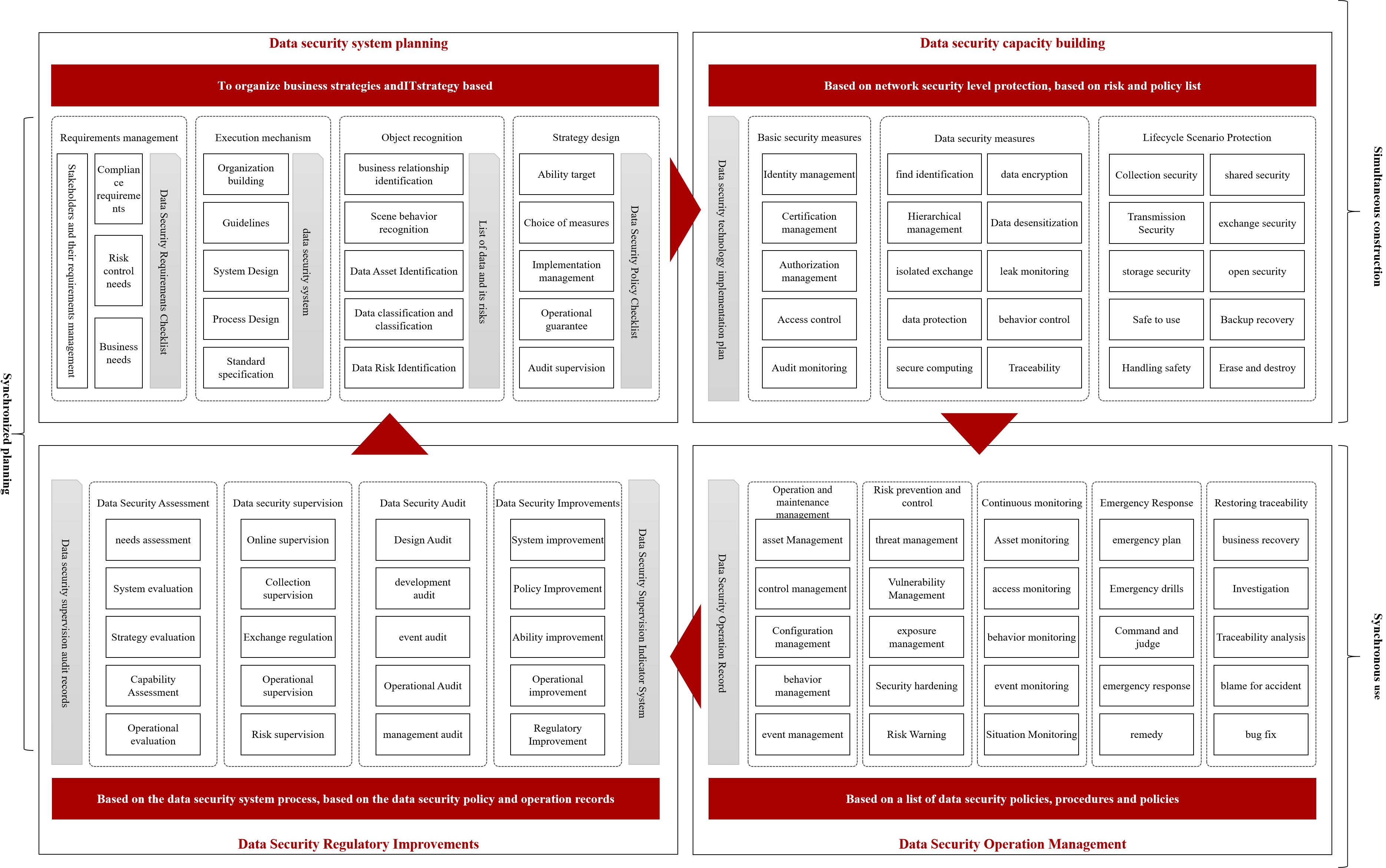
Centered on data as a key factor of production, and driven by compliance, risk management, and value protection, we adhere to the principle of "synchronized planning, synchronized construction, and synchronized operation." We begin with data security system planning to construct a comprehensive data security assurance system for clients, covering capability building, operational management, and regulatory enhancement. This ensures the security and controllability of data across all business operations, scenarios, processes, and throughout its entire lifecycle.

Data Security System Planning: In accordance with national laws, regulations, and industry standards, our professional service team conducts a comprehensive assessment of the client's current status and gaps in organizational structure, management systems, technical capabilities, and personnel proficiency. We combine this with the analysis of actual data flow paths and typical risk scenarios to design a data security governance system that meets regulatory requirements and aligns with business realities, providing a solid basis for the implementation of technical capabilities.

Data Security Capability Building: Focusing on data classification and grading protection requirements, we build a full-chain security protection system covering data collection, transmission, storage, processing, sharing, and destruction on a robust cybersecurity foundation. By deploying key technical capabilities such as access control, data loss prevention (DLP), and data auditing, we enable continuous risk monitoring and protection at each stage of the data flow, achieving visibility, controllability, and trustworthiness throughout the data lifecycle.

Data Security Operational Control Building: Integrating technology with management, we develop integrated operational capabilities covering data asset identification, classification and grading management, dynamic risk monitoring, security incident response, and full-process auditing. We establish a closed-loop operational mechanism encompassing daily operations, risk control, continuous monitoring, emergency response, and traceability recovery. This mechanism promotes the continuous implementation and optimization of data security strategies, enabling dynamic, normalized, and intelligent operations.

Data Security Regulatory Enhancement: Addressing both internal governance and external compliance requirements, we establish a standardized regulatory view based on authority-responsibility relationships and industry/regional regulatory demands. This view includes data asset inventories, classification and grading lists, critical data catalogs, and risk registers. Through standardized interfaces, we enable real-time aggregation and automated reporting of regulatory data, supporting an efficient, transparent, and traceable regulatory collaboration mechanism.

If you need this content structured as a slide deck, a summary for an executive brief, or adapted for a specific section of a larger proposal, please let me know, and I can assist further.
Comprehensive Strength
As a pioneer in the data security field among cybersecurity enterprises, Topsec took the lead in proposing the construction approach of a "data-centric security system." Leveraging years of experience in data security, the company introduced a "six-step" roadmap for building a data security governance system, which has been successfully implemented at scale in large-scale clients across more than ten sectors, including government, telecommunications, energy, finance, and education. In terms of standards development and national-level research initiatives, Topsec has contributed to the drafting of over 90 data security standards and specifications and participated in more than 50 major national scientific and technological projects, such as the National Key R&D Program and the Industrial Internet Innovation and Development Project. Regarding talent development, Topsec serves as the exclusive operating institution for the Certified Information Security Professional - Data Security Governance (CISP-DSG) certification and has trained thousands of data security governance professionals for the country. In 2022, in collaboration with the National Information Security Testing and Evaluation Center, Topsec launched the advanced-level Certified Information Security Professional - Data Security Officer (CISP-DSO) certification, further promoting the development of data security professionals in China toward greater specialization, comprehensiveness, and systematic expertise.