Stock Abbreviation : Topsec      Stock Code : 002212
24/7 Customer Service: 400-777-0777

Desktop Cloud Solution

This solution offers converged architecture, ultimate experience, security and reliability, flexibility and efficiency.

Background

As enterprises place increasingly higher requirements on office security, cost control, manageability, and business continuity, traditional enterprise PC architectures are reaching their limits. In traditional PC architectures, the operating system, personal data, and applications are tightly bound to each individual hardware device. A failure in any single component can cause operational downtime and require immediate maintenance. With the advancement of information technology, more job roles require PCs, leading to an ever-increasing number of endpoints that O&M teams must manage. Furthermore, traditional PCs function as isolated standalone devices. This creates immense complexity for O&M personnel across areas such as data security control, new desktop provisioning, software installation and management, complex security patch deployment, system upgrades, and version conflict resolution.
Activities & Announcements
Solution

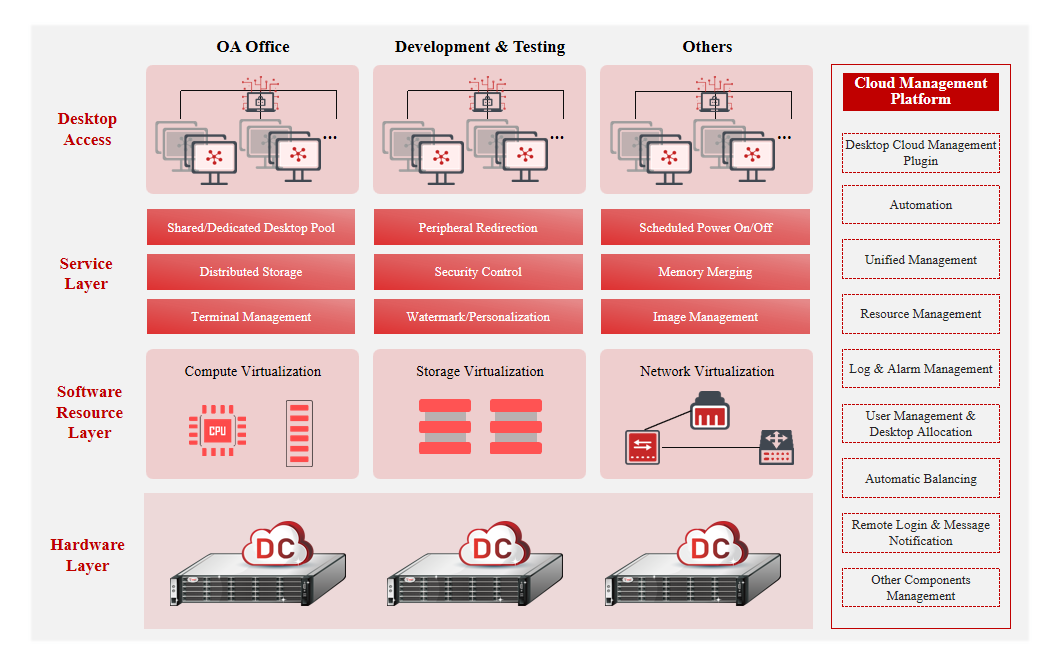
Built on Topsec's robust desktop cloud product R&D system, the Topsec Desktop Cloud Solution delivers an end-to-end architecture spanning underlying infrastructure (servers, storage, and networking), upper-layer software platforms (TopDC and TopEC), and specialized desktop endpoints.

  • Software Resource Layer: This layer virtualizes physical hardware resources while providing centralized orchestration of virtual and business resources. It exposes unified business and O&M APIs to seamlessly integrate with diverse upper-layer applications like desktop clouds. Hyper: Provides virtualization and lifecycle management for virtual resources, serving as the core computing engine. Storage: Manages distributed storage and the lifecycle of storage volumes, serving as the primary storage service provider. Network: Delivers virtualized networking capabilities to implement traffic isolation and network segmentation for cloud desktops.
  • TopDC Business Layer: By encapsulating underlying infrastructure capabilities, TopDC implements specific logic for upper layers. It handles core logic functions including desktop pools, storage volumes, cloud desktops, image repositories, policy-based scheduling, and automatic load balancing, acting as the central execution and decision-making engine for TopDC functionalities.
  • Desktop Access Layer (TopViewer): Utilizing a high-performance remote desktop control protocol, TopViewer enables users to connect to cloud desktops via thick or thin clients. Desktop graphics are efficiently streamed to remote displays, while peripheral devices on the client side are seamlessly mapped to the assigned cloud desktop through various redirection technologies, delivering an enhanced desktop experience.
  • Cloud Management Platform Layer (TopEC): Acting as the central administration plane, TopEC automates physical resource management, monitors resource utilization, collects logs, and triggers operational alerts. Additionally, it handles the ongoing management and orchestration of systems like TopDC.
Value to Customers
Lower Total Cost of Ownership
By utilizing infrastructure-layer virtualization along with thin clients and energy-efficient compute and storage resources, the platform reduces the construction costs of supporting power and cooling systems. Over the long term, this significantly drives down operational and maintenance expenses, substantially lowering the total cost of ownership of desktop infrastructure.
Robust Data Security
All user data processing, computing, and storage occur securely within the centralized data center. Because users only receive graphical display information over the network, confidential and sensitive data cannot be downloaded or stored locally on endpoints, dramatically minimizing data leakage risks.
Low-Carbon and Environmental Sustainability
Traditional PCs typically consume 150–200W of power, whereas thin clients require only around 10W—roughly 5% of a standard PC's power footprint. Even when factoring in data center server power consumption, the total energy footprint remains less than one-fifth of that in a traditional PC environment, delivering massive reductions in annual electricity costs.
Simplified Management and On-Demand Allocation
Administrators can centrally manage and configure all resources through a single unified console, streamlining workflows like system upgrades, software updates, and service provisioning. This eliminates the O&M complexity and difficulties caused by scattered traditional PCs. Furthermore, the desktop cloud system enables highly flexible, elastic resource allocation tailored to actual user demands.
Flexible Access
Users can securely access their applications and desktops from any network-accessible location, enabling high operational mobility. Furthermore, the entire workflow from desktop creation to user delivery takes only about ten minutes—saving more time compared to the days required for traditional physical PC procurement, shipping, and deployment.
High Stability and Reliability
Traditional PCs are scattered across fragmented locations and lack built-in redundancy, making a simple power outage or system error enough to trigger a complete device crash. In contrast, virtual desktops are centrally hosted in the data center, where multi-layered redundancy and backup mechanisms ensure significantly lower failure rates and maximum system uptime.
Applications

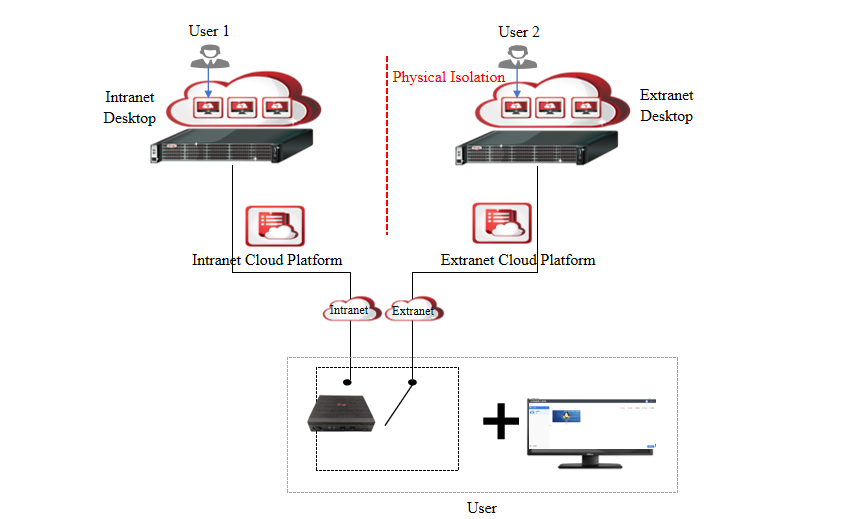
Government agencies, healthcare institutions, and financial organizations often operate across multiple network environments, necessitating secure isolation between internal and external networks. By deploying two physically isolated desktop cloud server clusters to independently host internal and external desktops, the platform ensures total network separation. Each employee is assigned a dual-port thin client with a built-in dual-network switch. By toggling the switch, a single endpoint can interface with multiple networks while strictly ensuring that only one network is active at any given time. This seamlessly satisfies stringent internal and external network isolation requirements.

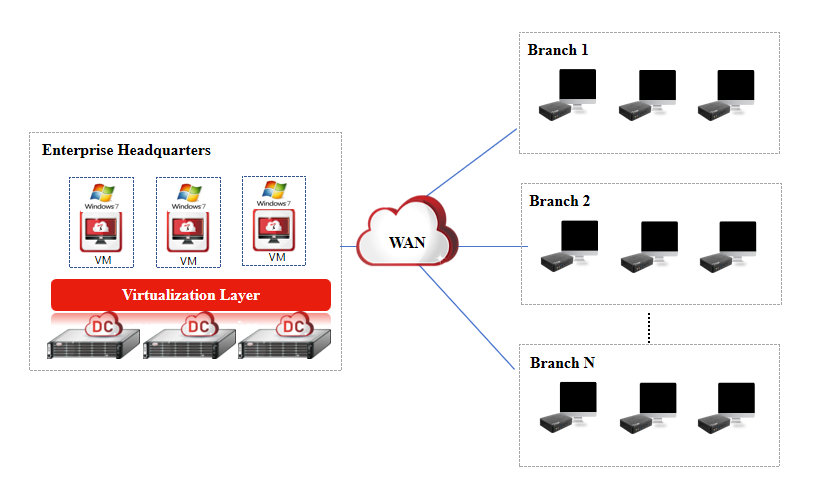
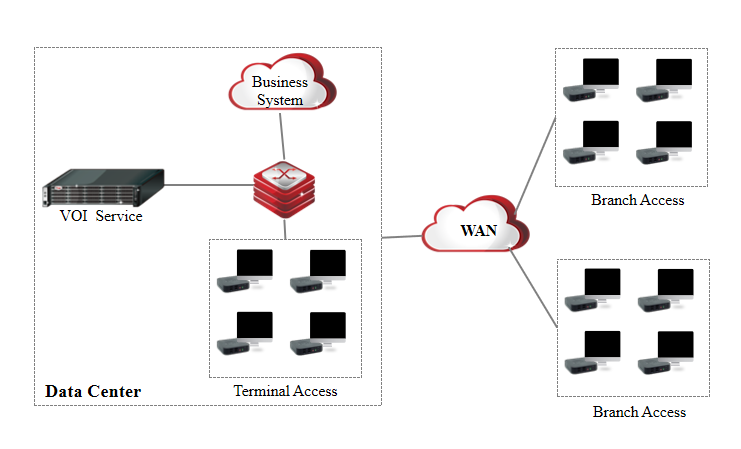
Large and medium-sized enterprises often operate multiple branch offices across different geographic locations, with endpoints distributed across various physical sites. In traditional environments, handling endpoint failures and business deployments requires O&M personnel to travel on-site for troubleshooting, which is time-consuming and inefficient. By adopting desktop cloud technology, enterprises only need to deploy a server cluster and desktop cloud platform at the central data center, while thin clients are deployed at branch offices. Branch users can seamlessly access virtual desktops via public Internet mapping or VPN connections. A central administrator then manages and allocates virtual desktops and thin clients in a unified manner, significantly improving O&M efficiency and data security.

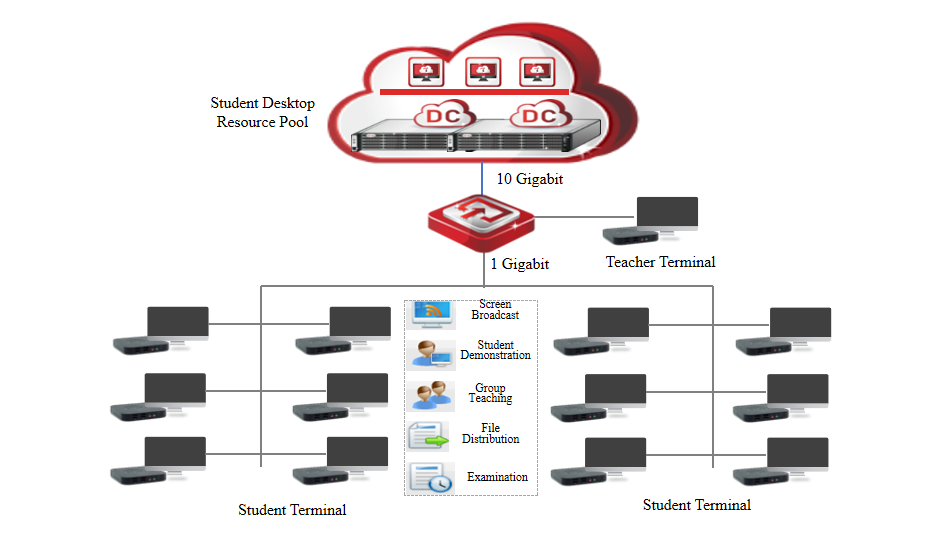
Primary and secondary schools, training institutions, and other organizations commonly establish training classrooms for knowledge transfer, software training, and hands-on practical exercises. Traditional PCs are highly prone to hardware component damage, blue screen errors, and system crashes. Furthermore, switching between different courses is slow and manual deployment is complex, creating massive overhead for O&M personnel. By deploying a desktop cloud server cluster in the central data center, student virtual desktop pools and course templates are hosted centrally, while thin clients, monitors, keyboards, and mice are deployed in classrooms. Upon class completion, desktops automatically revert to their baseline state after shutdown. Additionally, the solution integrates seamlessly with instructional software to enable interactive features such as screen broadcasting, assignment collection, student demonstrations, and digital roll calls.

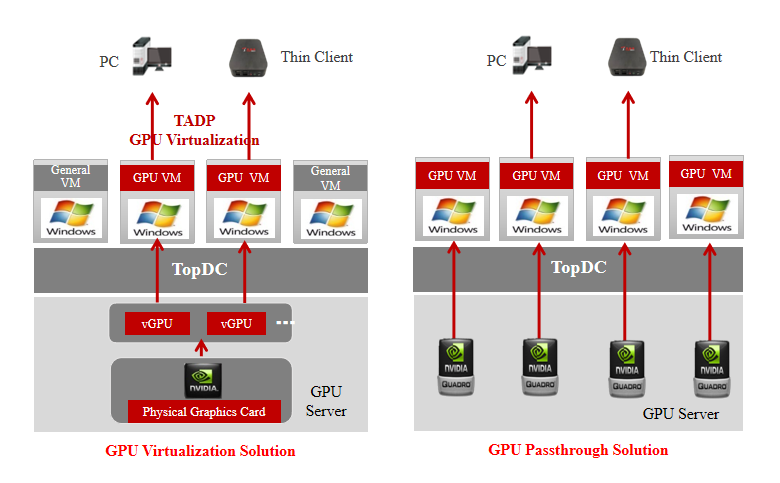
For demanding workloads such as 3D graphics rendering, 3D modeling, drawing instruction, and multi-track video editing, the Topsec Desktop Cloud provides robust GPU virtualization and GPU passthrough solutions to ensure fluid responsiveness and high-fidelity rendering for graphics-intensive applications. By slicing a physical NVIDIA GPU into multiple virtual GPUs (vGPUs) and binding them to multiple virtual desktops, or by granting virtual machines direct, dedicated access to the full hardware capabilities of the physical GPU, the platform effortlessly meets the varied rendering requirements of diverse 3D applications.

Critical environments such as bank call centers, hospital operating rooms, and medical imaging centers require maximum business continuity—ensuring that users can work seamlessly even if the network connection to the management server is lost. By deploying the Topsec VOI (Virtual OS Infrastructure) Desktop Cloud, an entry-level server is all that is required to provision and manage hundreds of thick clients, allowing users to operate within a local area network (LAN) or remotely via the Internet. Topsec VOI desktops feature seamless account roaming, dynamic data mobility, and rapid image deployment—fully meeting the stringent demands of offline operations, ultra-low latency, and reliable peripheral stability.

Product Recommendations
Solution Recommendations
Hyper-Converged Data Center Solution
This solution provides a hyper-converged technology architecture for deployment of private data centers.
Intelligent Computing Infrastructure Construction Solution
The solution provides customers with high-performance, secure, and reliable solutions for intelligent computing centers.